The image most people carry of ancient Roman dining involves elaborate feasts, reclining senators, and the kind of excess that requires several courses and a dedicated room. That was real — but it was also the experience of a small minority. For the vast majority of Romans living in urban areas, daily eating looked considerably more familiar: hot food, purchased quickly, eaten on the go or standing at a counter. Ancient Rome had a fast food industry — and it was more developed than most people realize.
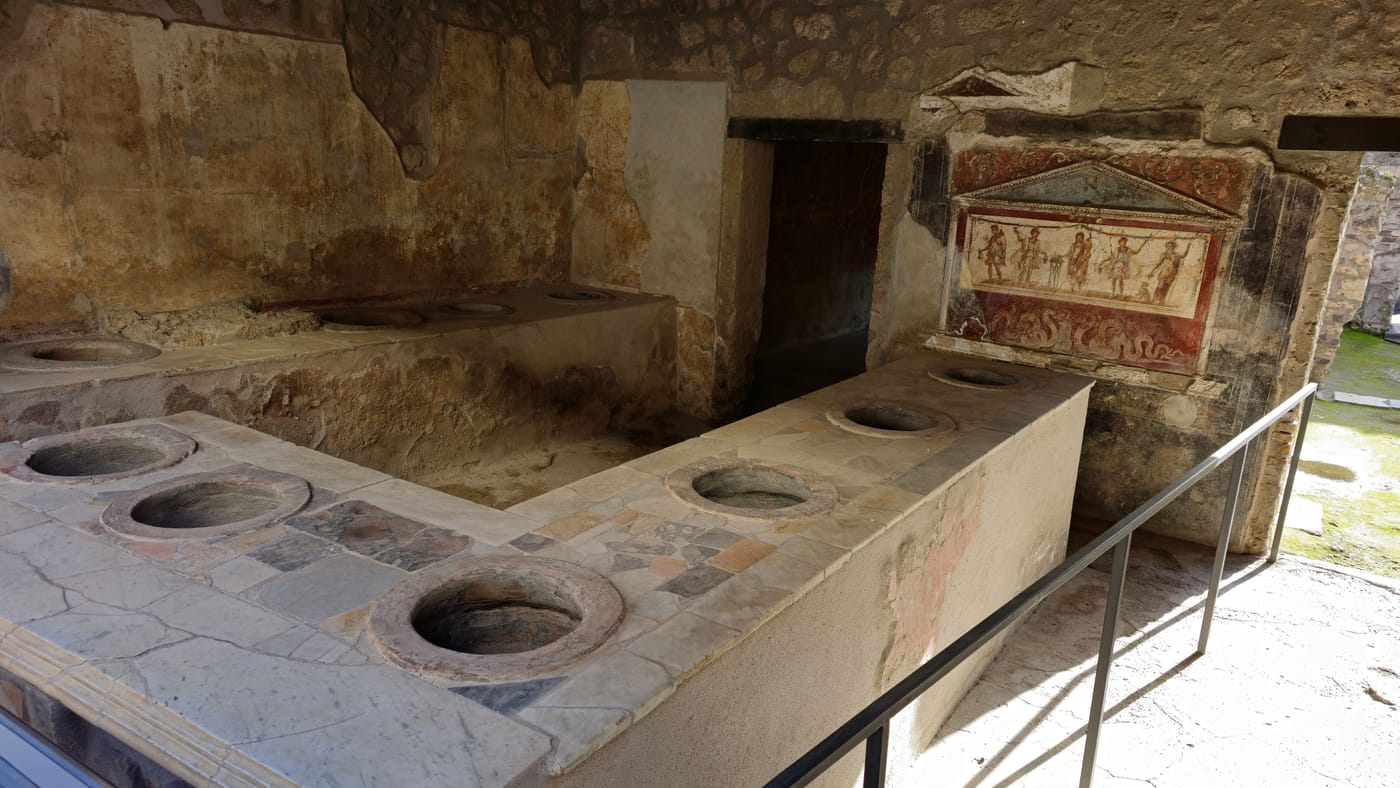
The establishments were called thermopolia — from the Greek for "a place where something hot is sold." They were built into the street-facing walls of buildings, with stone counters embedded with large ceramic jars called dolia that kept food warm throughout the day. Pompeii alone had over 80 of them. Customers walked up, pointed at what they wanted, and ate standing at the counter or took their food with them — the same transaction that happens at food counters around the world today, 2,000 years later.
The reason thermopolia were so essential comes down to Roman urban housing. Most city-dwelling Romans lived in multi-story apartment buildings called insulae, which had no kitchens. Open flames in densely packed wooden structures were a fire hazard the city couldn't afford — Rome had already burned catastrophically — so cooking at home simply wasn't an option for most of the population. Thermopolia weren't a convenience. They were a necessity. Eating out wasn't a luxury in ancient Rome; it was how the majority of the urban population ate every single day.
In December 2020, archaeologists excavating Pompeii's Regio V district announced a find that made international headlines: a perfectly preserved thermopolium, the first ever to be excavated completely intact. The counter was still decorated with vivid frescoes — a rooster, two mallard ducks, a dog on a leash, a Nereid riding a sea horse. The serving vessels were still in place. And the dolia still contained food: fragments of duck, pig, goat, fish, and snails, along with wine residue. The last meal this thermopolium had been preparing was still sitting in the containers when Vesuvius buried the city in 79 AD.
The frescoes served a specific practical function. A significant portion of Pompeii's population was illiterate, so the painted images above the counter acted as a visual menu — customers could see exactly what was being served that day without needing to read anything. The dog fresco may have functioned as a "beware of dog" sign, or simply reflected that the owner kept an animal on the premises. The level of detail preserved by the volcanic ash has allowed archaeologists to reconstruct the visual experience of walking up to this counter almost exactly as it appeared on the morning of the eruption.
The menu, by modern standards, was adventurous. Snails were a common street food across the Roman world — cheap, available, and easy to prepare in bulk. Duck appeared regularly. Fish stews were popular. And one item that would raise eyebrows today: dormice, small rodents that wealthy Romans raised in special clay jars called dolia raria, fattened on nuts and honey before being roasted. They weren't exclusively an elite food — versions of honey-roasted dormice showed up across the social spectrum, including at street level.
Thermopolia weren't just food counters. They functioned as social hubs — places where neighbors gathered, gossip circulated, and business was conducted. Many had back rooms or small outdoor areas with benches where customers could sit. Some served wine. Archaeological evidence from several Pompeii locations suggests gambling happened on the premises. The thermopolium was the Roman equivalent of the neighborhood bar, the diner, and the food truck, all rolled into one street-front counter.
The 2020 excavation is still being studied, and ongoing work in Regio V continues to uncover new examples. What the thermopolia collectively reveal is that the gap between ancient Roman daily life and modern urban life is considerably smaller than most people assume. The specific foods were different. The setting was different. But the experience of grabbing a hot meal from a counter on your way somewhere — that part hasn't changed at all.