In 1912, an amateur collector named Charles Dawson announced a find near Piltdown, Sussex. He said gravel beds there held the "missing link" between apes and humans.
He worked with Arthur Smith Woodward, Keeper of Geology at the Natural History Museum in London. With that backing, the Piltdown remains became a scientific sensation and a source of British pride.
The fossil stayed on the books for decades, even as other human ancestors turned up elsewhere and didn't fit the Piltdown pattern. It sat awkwardly in the story of evolution, yet few challenged it outright.
In 1949, museum geologist Kenneth Oakley tried a chemical approach. His fluorine tests suggested the remains were only about 50,000 years old, far too young to be an ancient link.
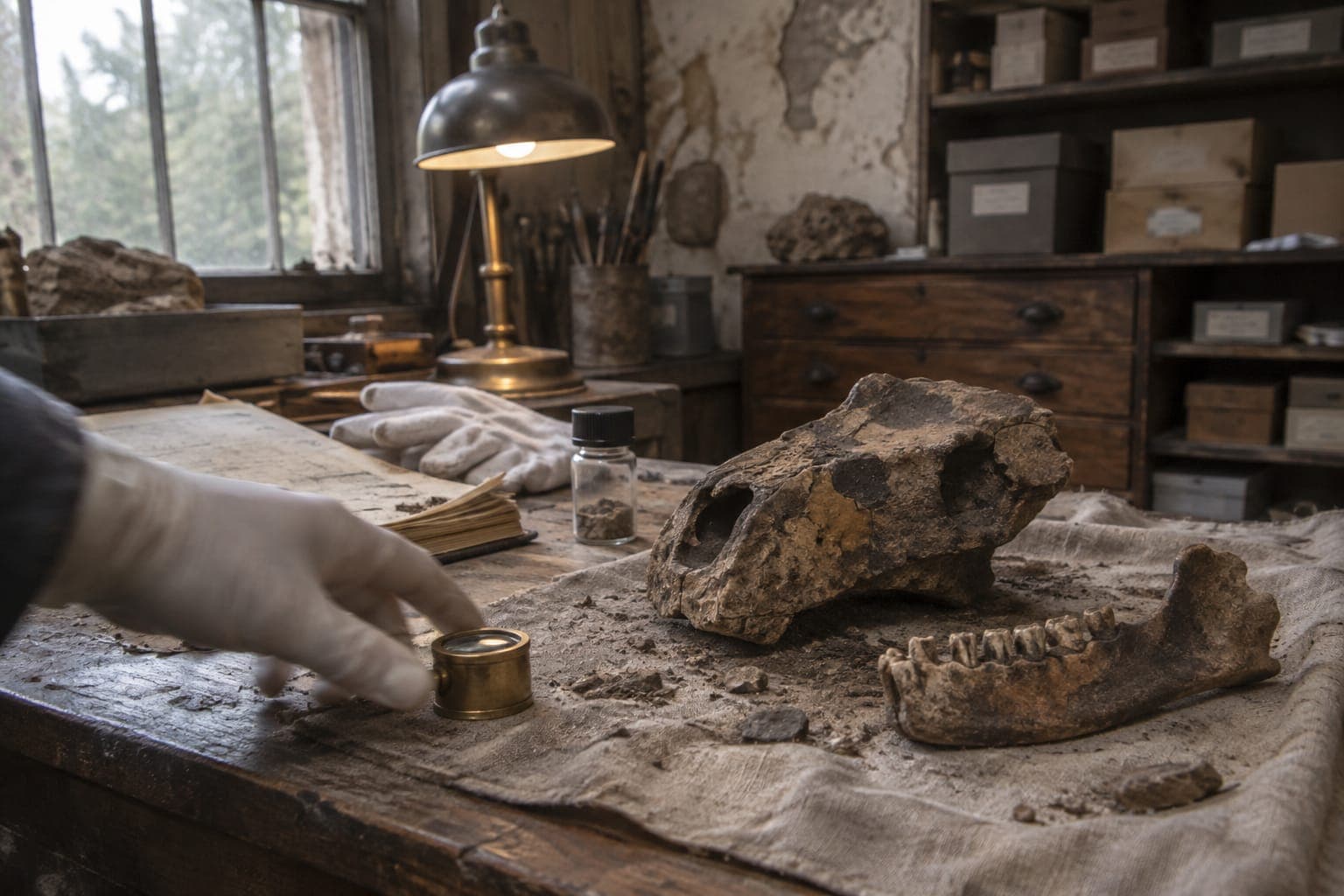
Oakley, Joseph Weiner and Wilfrid Le Gros Clark then looked closer. The skull and jaw came from two different species, a human and probably an orangutan.
Under the microscope, scratches showed the teeth had been filed down to look human. Most of the finds had also been stained to match the local gravels.
The exposure went public in November 1953, and the museum now calls it "an audacious fake and a sophisticated scientific fraud." Dawson is the likely culprit, but the forger is still officially unproven.