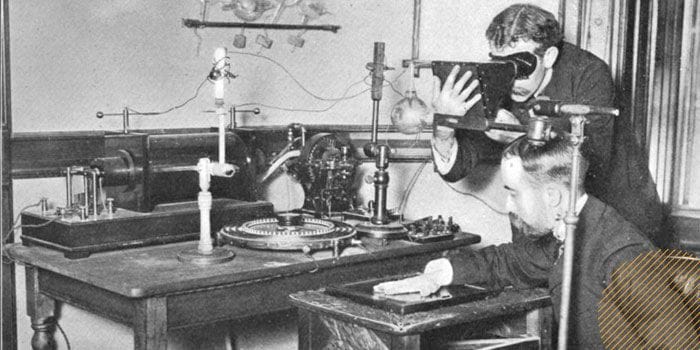
On November 8, 1895, a German physicist named Wilhelm Röntgen was working alone in his lab, experimenting with a cathode ray tube — a glass vacuum tube that shoots electrons when charged with electricity. He had covered it in black cardboard to block its light, but noticed something strange: a nearby screen coated in fluorescent material was glowing, even though it was across the room and the tube was covered.
Something invisible was passing through the cardboard and lighting up the screen. Röntgen had no idea what it was. He called it X-ray — the "X" standing for "unknown." For the next several weeks, he barely left his lab, sleeping there and skipping meals, trying to understand what he had found.
When he placed his hand in the beam's path, he could see the outline of his bones on the screen. When he placed a wooden box in the way, the rays passed right through it. He realized this invisible radiation could penetrate soft material but was blocked by denser substances — like bone, or metal.
A few weeks later, he asked his wife Anna Bertha to hold her hand still over a photographic plate while he aimed the tube at it. The image that developed showed every bone in her hand in sharp detail, her wedding ring sitting on her finger like a perfect white band. Anna reportedly looked at the photo and said, "I have seen my own death." She never wanted to participate in his experiments again.
Röntgen published his findings in December 1895, just seven weeks after his discovery. The scientific community reacted with a speed that was almost unheard of for the era. Within months, hospitals across Europe and North America were using X-ray machines to locate bullets in soldiers and set broken bones without surgery. What had taken surgeons hours of dangerous cutting could now be done in seconds.
The public reaction was a strange mix of wonder and horror. Newspapers ran sensational headlines. One company immediately began selling "X-ray proof underwear" to protect Victorian modesty from the idea that strangers could see through clothing. (They couldn't — the rays required a machine and a photographic plate — but the fear was real enough to sell products.)
Nobody understood at the time that X-rays were a form of ionizing radiation with real health consequences. Early radiologists and patients were exposed with no protection whatsoever. Several of the first people to work extensively with X-ray machines developed severe radiation burns, lost fingers, or died of radiation-related cancers — all while believing the technology was completely harmless.
Röntgen himself refused to patent his discovery, believing medical tools should be freely available to all of humanity. He donated his Nobel Prize money — awarded in 1901 for the first-ever Nobel Prize in Physics — to his university. He died in 1923, having never profited from one of the most consequential accidents in the history of science.
Today, X-rays are so routine that it's easy to forget what they actually are: invisible high-energy radiation, passing straight through your body, captured on a sensor in a fraction of a second. The basic physics Röntgen stumbled onto while playing with a glass tube in a darkened lab hasn't changed in 130 years. Only our understanding of it has.