Some of the most beloved toys in history share an origin story that has nothing to do with toy design. The Slinky, Play-Doh, Silly Putty, and the Super Soaker were all accidents — invented by engineers and chemists who were trying to solve completely unrelated problems, stumbled into something unexpected, and either recognized the potential themselves or had someone else recognize it for them. The toys themselves are iconic. The stories behind them are stranger.
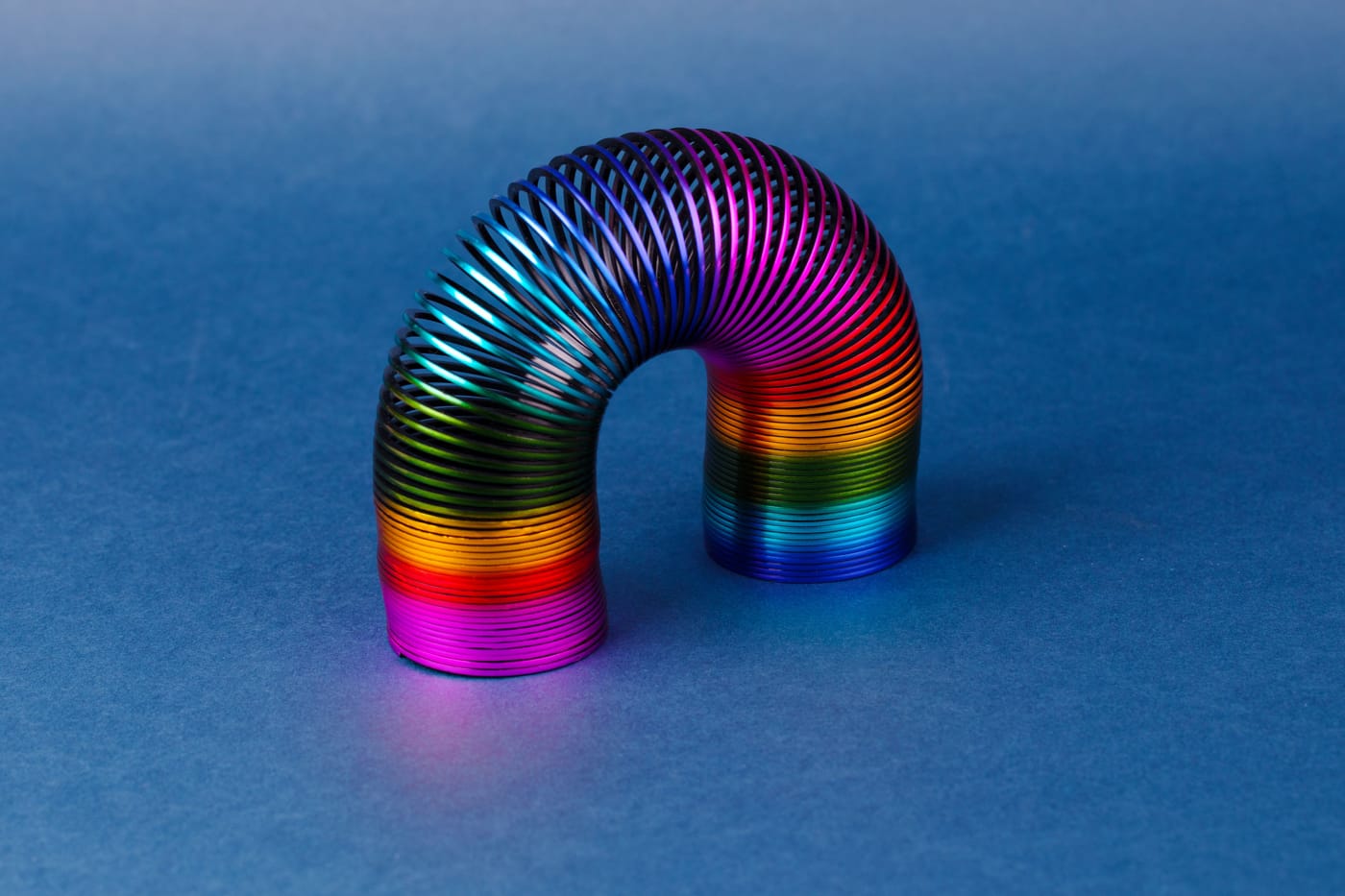
The Slinky began in a naval shipyard in 1943. Mechanical engineer Richard James was working on a device to stabilize sensitive instruments on ships at sea, testing tension springs that could keep equipment steady during rough conditions. One of the springs fell off his desk and kept moving — tumbling coil by coil across the floor rather than simply dropping. James watched it happen and told his wife Betty he thought it would make a good toy. She found the name "Slinky" in a dictionary. They borrowed $500, manufactured 400 units, and convinced Gimbels department store in Philadelphia to let them do a live demonstration for Christmas 1945. All 400 sold within minutes.
The company grew into a genuine success — and then Richard James abruptly abandoned it. By the late 1950s, he had become involved with a religious sect, eventually leaving his wife, six children, and company behind to move to Bolivia. Before he left, he funneled significant company funds to the organization. He died there in 1974. Betty James, left with six children and a company in financial trouble, took out a mortgage on their house, brought the Slinky to a New York toy fair in 1963, and relaunched it with a catchy television jingle. It sold again. She ran the company for decades.
Play-Doh started as a wallpaper cleaner. In the 1930s, a company called Kutol Products developed a pliable, non-toxic dough for cleaning coal soot off wallpaper — a product that was genuinely useful in an era when most homes were heated with coal. When cleaner-burning heating fuels replaced coal, the product became obsolete almost overnight. The company was facing financial collapse when a nursery school teacher named Kay Zufall — sister-in-law to Kutol's CEO — read an article suggesting that modeling clay could be used in children's education. She tried the wallpaper cleaner instead, found that children loved it, and convinced her brother-in-law to rebrand it as a toy. Play-Doh launched in 1956. More than $3 billion worth has been sold since.
Silly Putty came out of wartime desperation. During World War II, the Japanese invasion of Southeast Asia cut off the United States' main supply of natural rubber — a material critical for tires, boots, and military equipment. The U.S. government commissioned General Electric to find a synthetic alternative. Engineer James Wright was experimenting with silicone oil and boric acid when he created a strange, stretchy compound that bounced, stretched, and copied newsprint. It didn't work as rubber. Nobody knew what to do with it. For years, samples were sent to engineers around the world with a request for ideas. Nobody had any. Eventually a toy marketer named Peter Hodgson bought the rights to it for $147, packaged it in plastic Easter eggs, and sold it as a toy. By 1950, it was selling a million units every three days.
The Super Soaker was invented by a NASA engineer in his bathroom. Lonnie Johnson was a spacecraft systems engineer working on the Galileo mission to Jupiter in 1982 when he was experimenting with a homemade heat pump in his bathroom at home. A prototype leaked, shooting a stream of water across the room with enough force that Johnson immediately recognized what he had. He spent years developing a pressurized water gun in his spare time, pitching it to toy companies that largely ignored him. Larami Corporation eventually licensed the design in 1989. The Super Soaker launched in 1990 and became the top-selling toy in the United States within two years, generating over $200 million in sales. Johnson used the royalties to fund his own research company, where he continues to develop technology today.
The pattern across all of these stories is the same: someone was trying to solve a serious, practical problem, failed at it, and noticed something interesting in the failure. The spring that wasn't right for stabilizing ships. The cleaning compound that stopped being useful. The rubber substitute that didn't substitute for rubber. The heat pump that sprayed water across a bathroom. None of them were looking for a toy. What separated these outcomes from all the other accidental discoveries that went nowhere was a moment of recognition — someone looking at an unexpected result and asking a different question than the one they started with.
The toys you grew up with were not designed. They were noticed.