



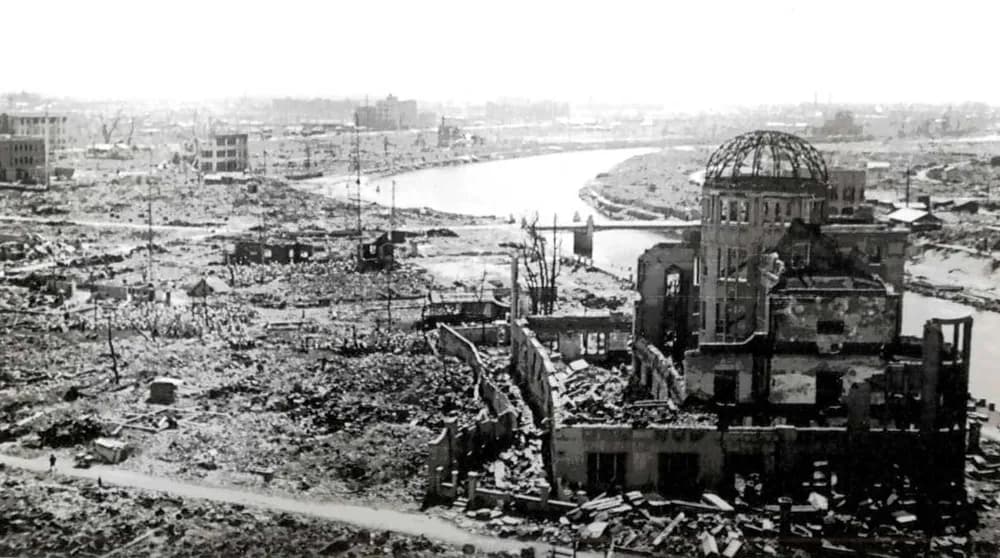
On the morning of August 6, 1945, Tsutomu Yamaguchi was walking to his workplace in Hiroshima when he realized he'd forgotten his ID stamp at the office. He turned back to get it. That small, forgettable errand put him on the street at exactly the wrong moment — or, depending on how you look at it, the right one. He was three kilometers from the center of the world's first atomic bomb blast when it detonated.
Yamaguchi was a 29-year-old naval engineer for Mitsubishi Heavy Industries, nearing the end of a three-month business trip. He looked up, saw the B-29 Enola Gay dropping something attached to parachutes, and then the sky turned white. The blast threw him into an irrigation ditch, ruptured his eardrums, temporarily blinded him, and left serious burns across the left side of his upper body. He lay in the ditch until the initial shock wave passed, then crawled out into a city that no longer existed in any recognizable form.
To reach the train station, Yamaguchi had to cross a river. The bridges were gone. He swam across using floating debris — and the bodies of the dead. He eventually found his two colleagues, who had also survived, and together they spent the night in an air-raid shelter. The next morning, they boarded a train home through a landscape of still-burning fires, shattered buildings, and tens of thousands of people who had not survived what Yamaguchi had.
He arrived in Nagasaki on August 8, badly burned and heavily bandaged, barely recognizable to his own family. A doctor friend from school didn't recognize him at first. His wife and infant son were safe. Despite his condition, Yamaguchi reported for work the following morning — August 9 — to explain to his supervisor what he had witnessed in Hiroshima. His boss was skeptical. One city, destroyed by a single bomb? It sounded impossible.
At 11:00 a.m., while Yamaguchi was mid-description, the room filled with blinding white light. The American bomber Bockscar had just dropped the second atomic bomb — Fat Man — over Nagasaki. Yamaguchi was again approximately three kilometers from the epicenter. He dove to the floor. His colleagues, having just heard his account of Hiroshima, instinctively took cover in the same way he had described. The office walls absorbed the blast. They survived again.
Yamaguchi stumbled home through the wreckage to find his wife and son alive, though his wife had been soaked in black radioactive rain. In the weeks that followed, he suffered radiation sickness, lost hearing in his left ear, went temporarily bald, and was wrapped in bandages for months. His children later recalled that until the youngest was 12 years old, their father was almost constantly bandaged. Despite everything, he recovered.
He worked as a translator for the American occupation forces, then returned to engineering, then became a teacher. For decades he said almost nothing publicly about what he had experienced. It wasn't until his eighties that Yamaguchi began speaking openly — writing a memoir, publishing poetry, appearing in documentaries, and traveling to the United Nations to plead for nuclear disarmament at the age of 90.
In March 2009 — less than a year before his death — the Japanese government officially recognized Tsutomu Yamaguchi as the only person in history to be formally acknowledged as a survivor of both atomic bombings. He died on January 4, 2010, at the age of 93, of stomach cancer. He had spent his final years trying to make sure what he survived would never happen to anyone else.