
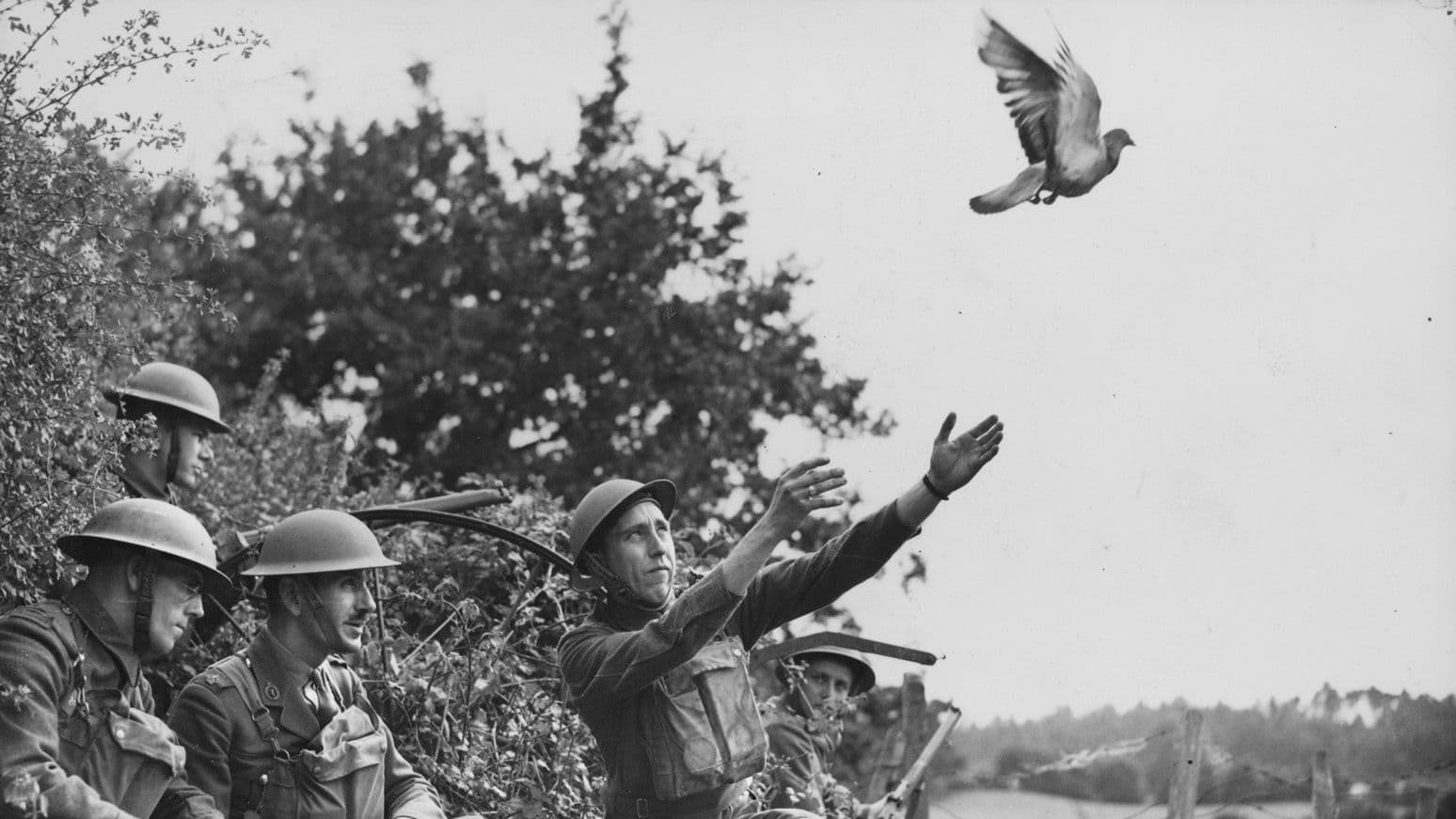
In October 1918, roughly 550 American soldiers were trapped in a ravine in the Argonne Forest in France — surrounded by German forces, cut off from reinforcements, running out of food and ammunition. Then, to make things catastrophically worse, their own artillery started shelling them by mistake. Their only way to communicate with the outside world was a single carrier pigeon named Cher Ami.
The U.S. Army Signal Corps had deployed around 600 carrier pigeons to the Western Front because radios were unreliable and telephone lines were constantly severed by artillery fire. Pigeons, it turned out, were fast, hardy, and remarkably good at finding their way home. An estimated 95% of messages sent by carrier pigeon on the Western Front reached their destination. German machine gun crews were trained specifically to shoot them down.
Major Charles Whittlesey, commanding the trapped battalion, had watched bird after bird get shot from the sky over the previous days. By October 4th, Cher Ami was the last pigeon he had left. Whittlesey dashed off a note and attached it to the bird's leg: "We are along the road parallel 276.4. Our own artillery is dropping a barrage directly on us. For heaven's sake stop it."
Cher Ami was released. The Germans saw the bird rise from the American position and opened fire immediately. Cher Ami was shot through the chest, lost a leg, and was blinded in one eye. The bird dropped. Then, somehow, got airborne again. Cher Ami flew 25 miles to the division's headquarters in approximately 25 minutes — arriving on his back, covered in blood, with the message capsule dangling from what remained of his leg.
The shelling stopped. The exact coordinates of the Lost Battalion — as the trapped men became known — were relayed to command, and relief efforts began. 194 men walked out of that forest alive. Army medics saved Cher Ami's life, amputated the ruined leg, and the soldiers of the Lost Battalion carved him a small wooden replacement.
The French government awarded Cher Ami the Croix de Guerre with Palm — one of France's highest military honors for gallantry. General John Pershing, commander of American forces, said: "There isn't anything the United States can do too much for this bird." Cher Ami returned to the United States to enormous public acclaim in April 1919.
The chest wound never fully healed. Cher Ami died in June 1919 — eight months after the flight that made him famous. The Army donated his remains to the Smithsonian Institution, where he remains on display today, a one-legged, one-eyed pigeon in a glass case, with the capsule that carried his last message displayed alongside him.
A century later, DNA testing confirmed what had long been uncertain — Cher Ami was male, despite decades of being referred to with female pronouns in Signal Corps records. He was inducted into the Racing Pigeon Hall of Fame in 1931 and received the Animals in War and Peace Medal of Bravery in 2019 — a hundred years after the flight. Some acts of courage, it seems, don't expire.