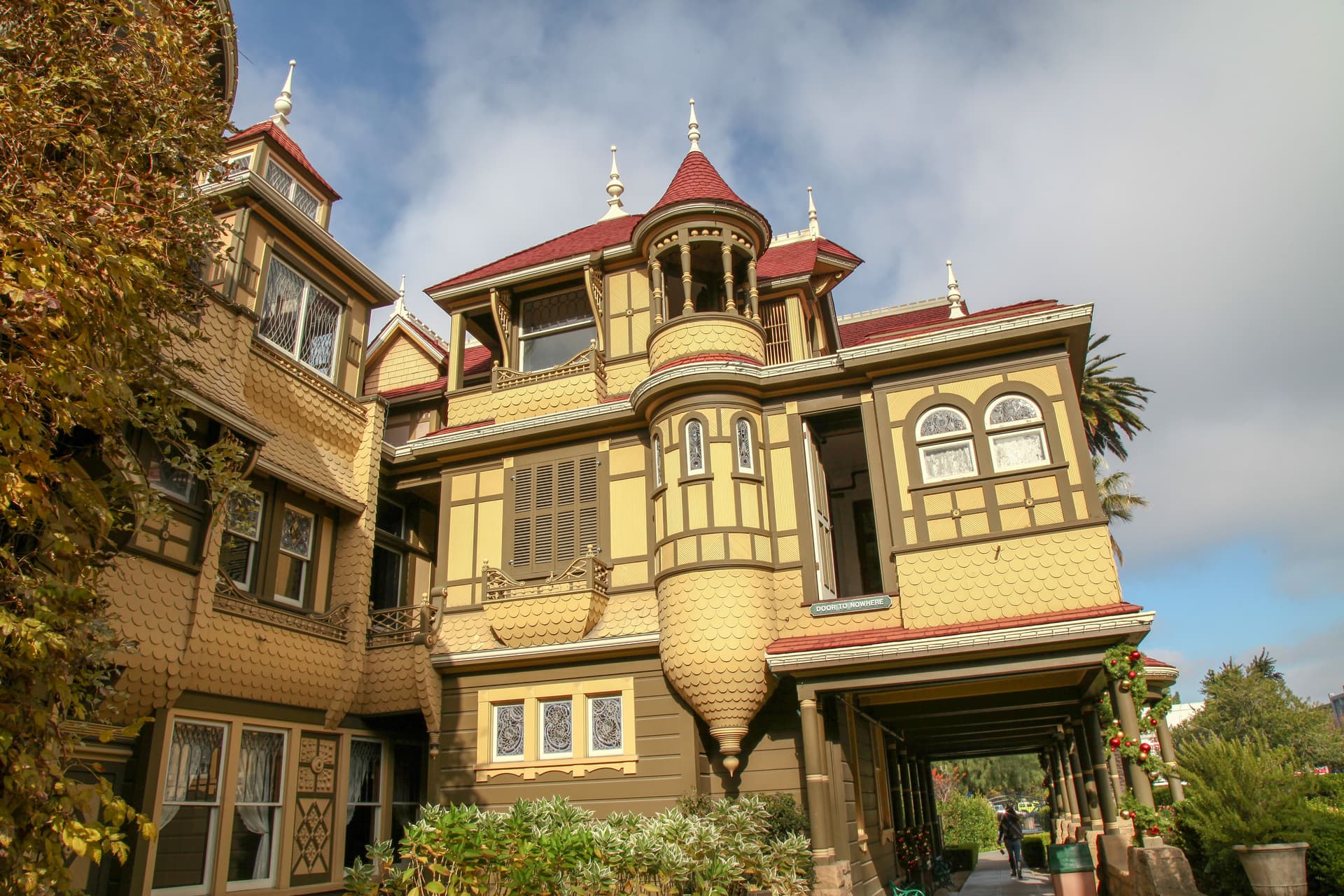
In San Jose, California, there is a 160-room Victorian mansion with staircases that lead directly into ceilings, doors that open onto solid walls, windows built into floors, and corridors that double back on themselves with no apparent purpose. It was built continuously for 36 years by a woman named Sarah Winchester — and the story most people know about why she built it is almost entirely false.
The popular version goes like this: Sarah Winchester, widow of the Winchester rifle fortune, was told by a medium that she was haunted by the souls of everyone killed by Winchester guns. To appease them, she had to build a house and never stop. The moment construction stopped, she would die. This story has been repeated in books, documentaries, a Hollywood film, and tour guides for over a century. There is no historical evidence for any of it.
The origin of the ghost story has been traced to a 1967 book called Prominent American Ghosts, whose author claimed to have sourced the tale from a Boston medium who supposedly advised Sarah in the 1880s. No corroborating records exist. People who actually knew Sarah — carpenters, household staff, legal advisors, family members — consistently described her as sharp-witted, independent, deeply intelligent, and not remotely superstitious. Her attorney, who managed her affairs for decades, left no account of anything resembling a haunting.
What was Sarah Winchester actually doing? The more likely explanation is considerably more interesting. She was a woman with a genuine passion for architecture, unlimited money, and no one to answer to. Her father was a master woodworker. She had studied design and had strong opinions about construction. Building the house appears to have been, for Sarah, an obsessive creative project — one that incorporated design innovations decades ahead of their time, including forced-air heating, push-button gas lighting, and an early elevator.
The architectural oddities have more mundane explanations too. The staircases to nowhere and doors opening onto walls were largely the result of constant remodeling — rooms built, then incorporated into new additions, then built around again over decades. The 1906 earthquake caused significant damage and dramatically altered the structure of the house. What looks like deliberate chaos from the outside was, in many cases, simply the result of 36 years of continuous change by someone who kept changing her mind.
The ghost story, meanwhile, was invented and embellished by the tourist industry after Sarah's death in 1922. The house was sold and opened to tours just nine months after she died, and the new owners quickly realized that a haunted mansion attracted more visitors than an eccentric widow's passion project. Every layer of supernatural mythology added after that point was marketing — and it worked extraordinarily well for a hundred years.
What the real Sarah Winchester left behind is, if anything, more compelling than the legend. She built one of the most architecturally unusual private residences in American history, largely on her own terms, at a time when women of wealth were expected to sit quietly and donate to charity. She employed dozens of workers for decades, many of them recent immigrants, and housed several families on her property. She was, by most accounts, a good employer and a generous philanthropist.
The Winchester Mystery House is genuinely mysterious — but not because of ghosts. It's mysterious because a brilliant, grieving, enormously wealthy woman spent 36 years building something no one fully understands, and then died without ever explaining why. The actual story doesn't need the supernatural. It's strange enough on its own.