




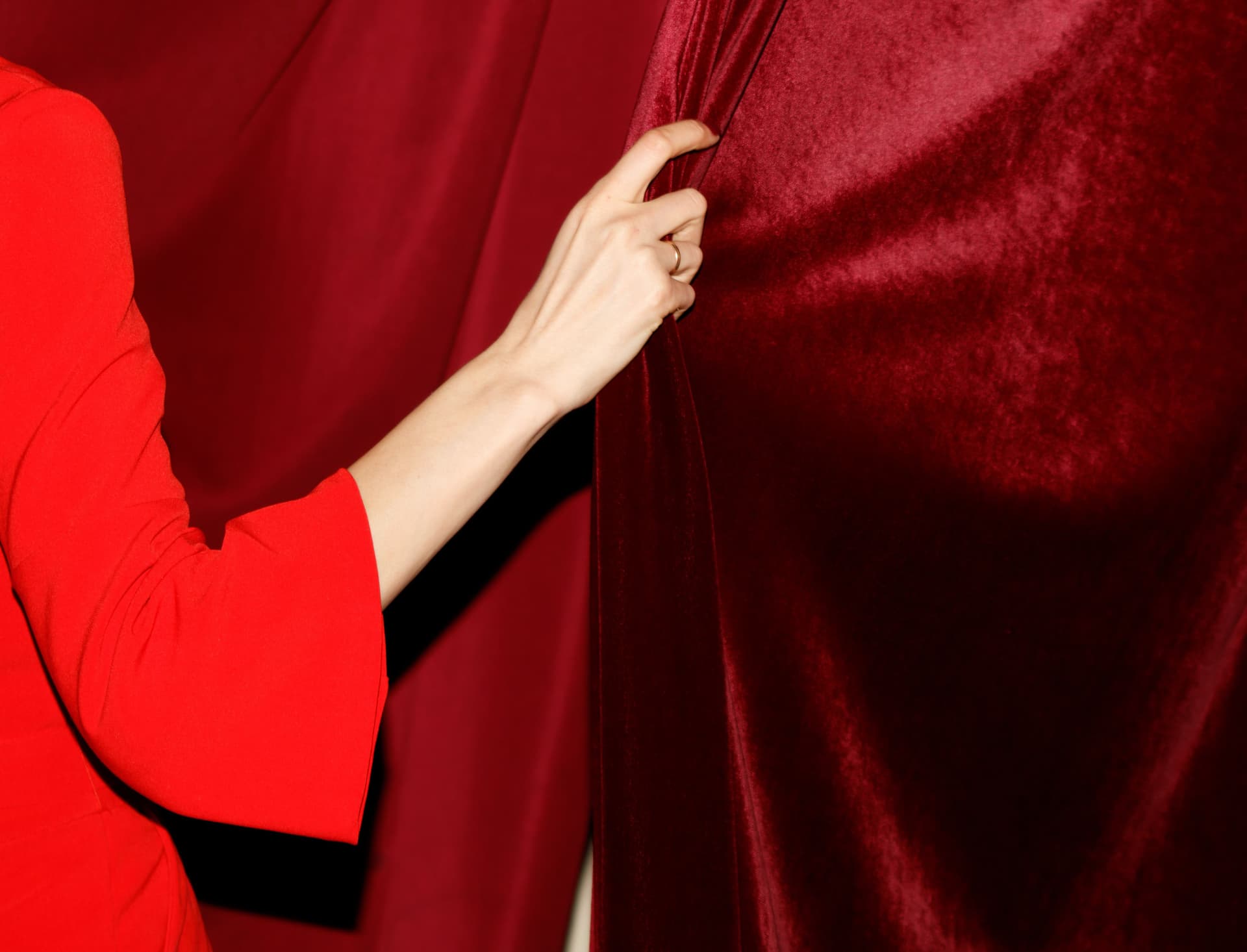
You probably know someone who can't stand the feeling of velvet. Maybe that person is you. The reaction is hard to explain — it's not painful, exactly, but it's deeply unpleasant in a way that feels almost physical. Most people chalk it up to personal preference and move on. But researchers who study how the brain processes touch have a different explanation, and it's a lot more interesting than "some people just don't like it."
The problem starts with velvet's structure. Unlike cotton, silk, or linen — which give your fingertips consistent, predictable feedback — velvet has a dense pile of upright fibers that behave differently depending on which direction you stroke them. Run your fingers one way: smooth. The other way: resistant, almost bristling. The surface looks uniform but feels inconsistent, and that gap between what your eyes expect and what your fingers actually feel is where things go wrong for some brains.
Neuroscientists call this "sensory incongruence." When the brain receives conflicting signals from the visual and tactile systems simultaneously, it treats the mismatch as a potential problem to solve — and for some people, that conflict registers as genuine distress. The anterior cingulate cortex, a region involved in error detection and conflict monitoring, activates. The amygdala, the brain's threat-assessment center, can get pulled in too. What starts as touching a piece of fabric ends up routed through the same neural machinery your brain uses to detect danger.
This isn't a fringe reaction. Researchers estimate that somewhere between 15 and 20 percent of the population are "highly sensitive persons" — people whose nervous systems process sensory input more intensely than average. For these individuals, certain textures don't just feel unpleasant; they feel genuinely threatening. Velvet consistently ranks among the most commonly reported triggers, alongside sounds like nails on a chalkboard or the feeling of dry cotton balls.
Part of what makes velvet so uniquely aggravating is that the discomfort isn't easy to rationalize away. Your brain knows velvet isn't dangerous. But the sensory signal it's sending — inconsistent, slightly resistant, impossible to fully predict — mimics the kind of feedback you'd get from touching something biologically significant. Some researchers have noted that the neural signature of touching velvet can resemble the sensation of touching insect wings or fine animal fur, textures that a more primitive version of the human brain was wired to treat with caution.
The condition has a name: tactile defensiveness, a documented subset of sensory processing sensitivity in which the nervous system over-responds to touch input. It frequently appears alongside conditions like autism spectrum disorder and ADHD, but it also exists on its own in otherwise neurotypical people — a quirk of how a particular nervous system happens to be wired, with no broader diagnosis attached.
What's strange is how specific it can be. Someone with velvet aversion might have no reaction whatsoever to suede, faux fur, or fleece — all fabrics with similar softness profiles. It's the specific combination of velvet's visual smoothness and tactile unpredictability that trips the wire. The brain isn't reacting to softness. It's reacting to the contradiction.
So the next time someone at a furniture store recoils from a velvet couch like they've touched something dangerous — they kind of have. At least, that's what their nervous system decided in the fraction of a second before logic had a chance to weigh in. The brain doesn't always wait for a second opinion.