Trending Now

The Accidental Invention Behind Beaded Ice Cream

The Accidental Invention Behind Beaded Ice Cream

One of these claims about a famous beaded ice cream's strange origin is true, and one isn't. Can you guess which one really happened?

Read more
A Command Sent Today Won't Land Until Tomorrow

A Command Sent Today Won't Land Until Tomorrow

A NASA probe is about to hit a milestone no other human-made object has reached.

Read more

The Wild Story of a Broken Tour de France Bike

One of these claims about an early Tour de France mishap is true, and one isn't. Can you guess which story really happened? Find out inside.

Read more
The Year America Served Two Thanksgivings

The Year America Served Two Thanksgivings

In 1939, families argued over which Thursday was the real one. A retailer's pitch started it all.

Read more
A Siberian Tomb Just Failed a 2,800-Year-Old Drug Test

A Siberian Tomb Just Failed a 2,800-Year-Old Drug Test

Researchers tested a princely tomb in southern Siberia and found something surprising in the hair.

Read more
See All Content
logo
  • Sports

  • History

  • Language

  • Food

  • Tech

  • Animals

  • Sports
  • History
  • Language
  • Food
  • Tech
  • Animals
  • ​
History FactsFun Facts

The Dead Frog That Started a Feud and Changed the World

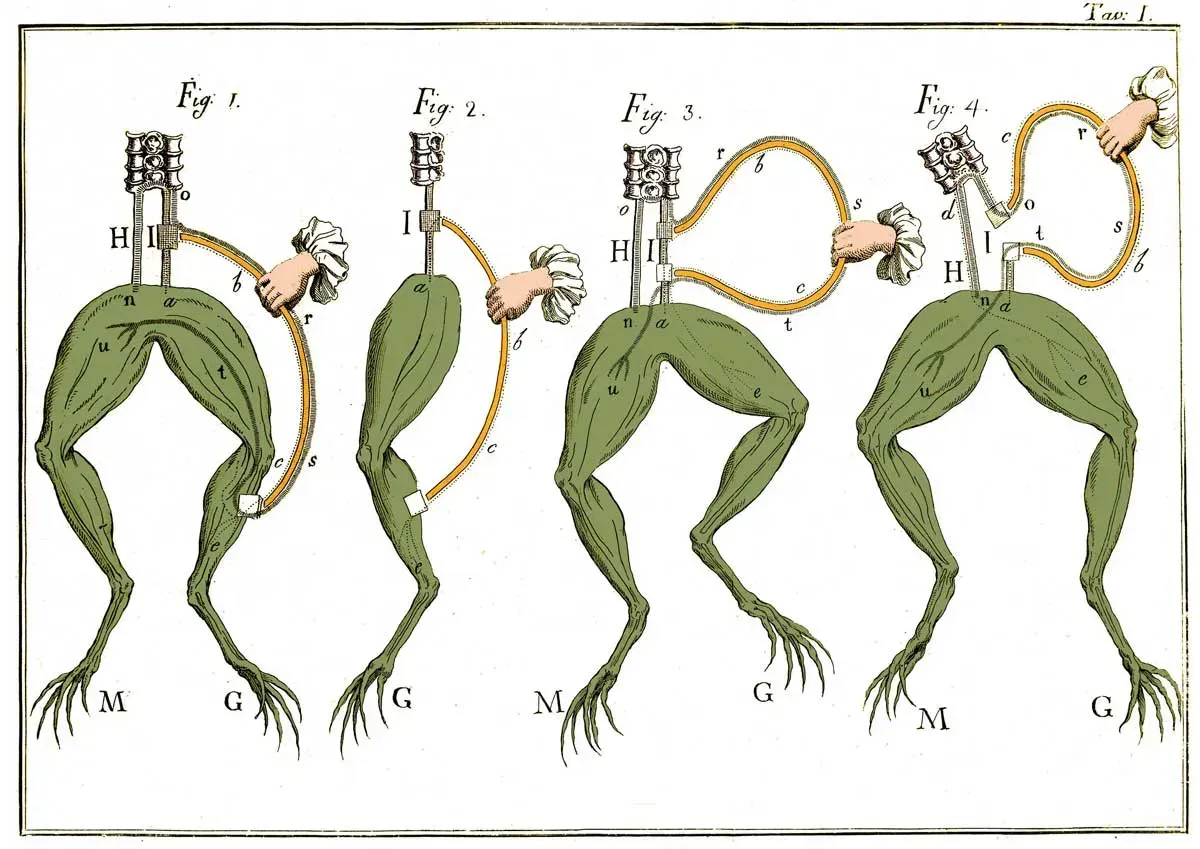
Vintage scientific illustration of frog electricity experiment

In 1780, an Italian anatomy professor named Luigi Galvani was running electrical experiments in his Bologna laboratory when one of his assistants made a small, unremarkable mistake. A metal scalpel accidentally brushed against the exposed nerve of a dissected frog leg — and the leg twitched. The frog was dead. There was no electrical current running through the room at that moment. There was no obvious reason for the leg to move. And yet it did.

Galvani spent the next decade trying to figure out what he'd seen. Through careful experimentation, he found that hanging frog legs on copper hooks and touching them with iron probes caused the same twitching — without any external electricity source. He concluded, reasonably but incorrectly, that living tissue contained its own innate electrical force — what he called "animal electricity." He published his findings in 1791 and became briefly famous across Europe. Scientists everywhere began recreating his experiments with dead frogs. It was one of the strangest trends in the history of science.

One of those scientists was Alessandro Volta, a professor of physics from Pavia who had previously considered himself Italy's leading authority on electricity. Volta initially supported Galvani's findings — then studied them more carefully and decided Galvani was completely wrong. The electricity wasn't coming from the frog. It was coming from the two different metals — the copper hook and the iron probe — reacting chemically with the frog's moist tissue, which was acting as a conductor. The frog's leg was twitching because current was flowing between dissimilar metals through a biological electrolyte. The animal had nothing to do with it.

What followed was one of the most pointed scientific disputes of the 18th century. Volta didn't simply publish a rebuttal — he conducted a systematic campaign to humiliate Galvani, publicly calling him misguided and designing experiments specifically intended to demolish his theory. Galvani, who was by most accounts a quiet and reserved man, mostly refused to engage directly. He died in 1798, still believing in animal electricity, without knowing that his dead frog had set something far more important in motion.

Because in trying to prove Galvani wrong, Volta built something extraordinary. If electricity flowed between two different metals separated by a moist conductor, Volta reasoned, you could stack that arrangement repeatedly to produce more current. He built alternating discs of zinc and silver, separated by cardboard soaked in saltwater, stacked into a column — and produced the first steady, reliable, continuous source of electrical current in history. He called it the voltaic pile. We call it the battery. The year was 1800.

The voltaic pile changed everything. Before it, scientists studying electricity had only static charges — brief, unpredictable bursts that couldn't be controlled or sustained. Volta's battery gave them a continuous current they could direct, measure, and use. Within years, researchers were using it to decompose water into hydrogen and oxygen, to discover new elements, to understand chemical reactions at a fundamental level. The entire trajectory of electrical science — which eventually produced telegraphs, lights, motors, and every device that runs on a battery today — traces directly back to that column of metal discs.

The frog experiments also had a cultural legacy Galvani never anticipated. His demonstrations of electricity reanimating dead tissue captured the public imagination across Europe — including that of a young writer named Mary Shelley, who attended lectures on galvanism and electrical reanimation before sitting down in 1816 to write a story about a scientist who used electricity to bring the dead back to life. She named her creation Frankenstein.

Galvani was wrong about animal electricity. Volta was right that the current came from the metals. But without Galvani's dead frog, Volta would have had nothing to argue with — and without that argument, the battery might have arrived decades later, or not at all. Science has rarely been so productively wrong.


Related Content

History Facts

17 November 2026

Post

The Year America Served Two Thanksgivings

In 1939, families argued over which Thursday was the real one. A retailer's pitch started it all....

History Facts

14 November 2026

Post

A Siberian Tomb Just Failed a 2,800-Year-Old Drug Test

Researchers tested a princely tomb in southern Siberia and found something surprising in the hair....

History Facts

13 November 2026

Post

The Novel That Gave Wall Street a Date to Dread

A 1907 book about a broker and a bad-luck Friday may have helped spook an entire market....

History Facts

11 November 2026

Post

One Minute Before Peace, He Charged

A bank clerk, a censored letter, and a final charge on the last morning of a world war....

History Facts

Fun Facts

10 November 2026

Post

A Hostage Waits at the Palace Whenever the King Visits

Every year, a politician is held at a palace so the monarch comes home safe. Here's why....

History Facts

Fun Facts

10 November 2026

Post

The Strange Story of Gunpowder and Pigeon Droppings

One of these claims about England's old gunpowder-and-pigeon-dung business is true, and one isn't. Can you guess which one really happened?...

History Facts

Fun Facts

10 November 2026

Post

Viagra Facts: A Heart Drug, Blue Vision and Hamsters

Why Viagra began as a heart drug, how it can tint your vision blue and why the FAA cares, and the hamster jet lag study that won an Ig Nobel Prize....

History Facts

Fun Facts

09 November 2026

Post

Cannibalism: 3 True Stories You Won't Believe

Which state bans cannibalism, why the CDC warned about placenta pills, and how a tribe's funeral ritual may have left a gene that fights brain disease....

History Facts

Fun Facts

09 November 2026

Post

The Laughing Sickness That Shut Down Schools

In 1962, three schoolgirls started laughing and a whole region couldn't stop. Nobody was joking....

History Facts

Fun Facts

09 November 2026

Post

The Surprising Origin of the Movie Trailer

One of these claims about the first movie trailer is true, and one is completely made up. Can you guess which one really happened?...

Language Facts

Fun Facts

08 November 2026

Post

Your Latte Art Is Named After a Monk's Hood

A Sunday coffee order shares its name with a monk's wardrobe and a monkey. Here's the link....

Tech Facts

Fun Facts

08 November 2026

Post

How NASA Sends Tools to Astronauts in Orbit

One of these claims about NASA and tools for astronauts is true, and one is completely made up. Can you guess which one really happened?...

History Facts

Fun Facts

08 November 2026

Post

Tattoos: The Iceman, Ink in Your Nodes (+1 More)

Ötzi's 5,300-year-old tattoos, where your tattoo ink really travels in your body, and the company that frames a dead loved one's actual tattooed skin....

History Facts

Fun Facts

07 November 2026

Post

The Taboo Word That Broke Through Ad Breaks

One of these claims about a taboo word in a 1980s TV commercial is true, and one is completely made up. Can you guess which one really happened?...

Sports Facts

Fun Facts

07 November 2026

Post

Why a Marathon Is Exactly 26.2 Miles Long

The odd number behind every marathon traces back to one summer day in London. Here's how it happened....
Terms and ConditionsDo Not Sell or Share My Personal InformationPrivacy PolicyPrivacy NoticeAccessibility NoticeUnsubscribe
Copyright © 2026 Fun Fact Feed