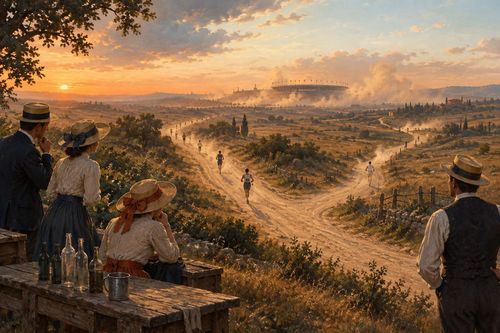
Every runner who crossed a finish line in New York this week covered the same oddly specific distance: 26.2 miles. It's a strange number to build a sport around, and it wasn't chosen for any tidy reason.
The first modern Olympic marathon, in Athens in 1896, ran about 40 kilometers. For the next few Games, the race stayed close to 25 miles, with the exact length shifting from one host city to the next.
Then came London in 1908. Organizers laid out a course that began at Windsor Castle and ended in front of the royal box at the stadium, and that route measured 26 miles and 385 yards.
A popular story says Queen Alexandra asked for the start to be moved so her young children could watch from the nursery window. That part is disputed, though. One historian of the race has said there was no such royal demand, so treat it as legend.
What is not disputed is the finish. Italian pastry chef Dorando Pietri, only about 5 feet 2 inches tall, entered the stadium first, then staggered and fell repeatedly in front of roughly 250,000 spectators.
Officials helped him across the line, and he was disqualified for that outside aid. American Johnny Hayes, who finished on his own, was declared the winner. Pietri still got a gold cup from the queen and a hit song by Irving Berlin.
The distance stuck. In 1921, governing officials formally fixed the marathon at 42.195 kilometers, or 26.2 miles, copying the length of one royal-adjacent course from that chaotic London afternoon.