Every New Year's Eve, a million people crowd into Times Square to watch a glittering ball drop at midnight. But the very first ball drop in 1907 was a terrifying near-disaster that almost killed the crowd below.
The tradition started because New York City had banned fireworks displays in Times Square after too many accidents. The New York Times, which owned the building and had been hosting massive New Year's celebrations, needed a new spectacle to draw crowds.
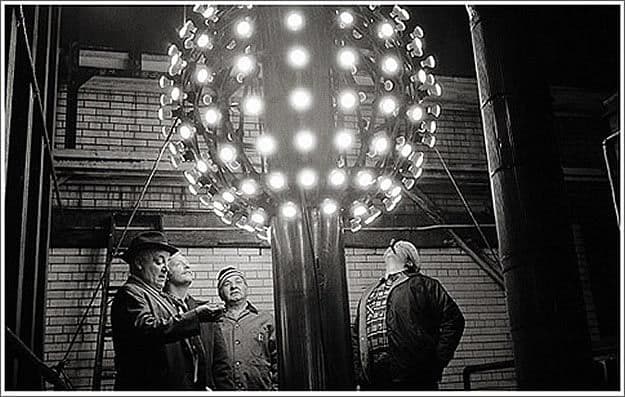
An immigrant metalworker named Jacob Starr was hired to create a "time ball"—a massive sphere that would descend from the top of the Times Tower to mark midnight. Time balls were already used at harbors to signal noon to ships, but never for a public celebration like this.
Starr built a ball that was 5 feet in diameter and weighed 700 pounds, made of iron and wood, covered in 100 twenty-five-watt light bulbs. It was an enormous, heavy object that would drop 70 feet down the side of a building—directly above thousands of people.
On December 31, 1907, as midnight approached, the ball began its descent. About halfway down, the mechanism faltered. The ball jerked, swayed, and for several terrifying seconds, looked like it might break free and crash into the packed crowd below.
People in the crowd started screaming and trying to run, but Times Square was so densely packed that nobody could move. If the 700-pound iron ball had fallen, it would have killed or seriously injured dozens of people. Somehow, the mechanism held, and the ball completed its drop.
Nobody in charge seemed to think "maybe we shouldn't drop a massive iron ball over a crowd of people" was a valid concern. The event was deemed a success because nobody died. The New York Times declared it a new tradition and committed to doing it every year.
The ball was redesigned multiple times over the decades, each version slightly less deadly than the last. The 1920 version was made of wrought iron and weighed 400 pounds. The 1955 version was aluminum and weighed 150 pounds. Engineers kept making it lighter after realizing dropping heavy objects on crowds was maybe a bad idea.
The modern ball, installed in 2008, weighs 11,875 pounds—but it doesn't actually "drop" anymore. It's permanently mounted on the roof and slowly descends on a computerized track with multiple backup systems. It's basically impossible for it to fall now.
Today, over a billion people worldwide watch the Times Square ball drop on TV. Very few know that the tradition started with a poorly-engineered iron sphere that nearly massacred a crowd in 1907—and that we kept doing it anyway because it looked cool!