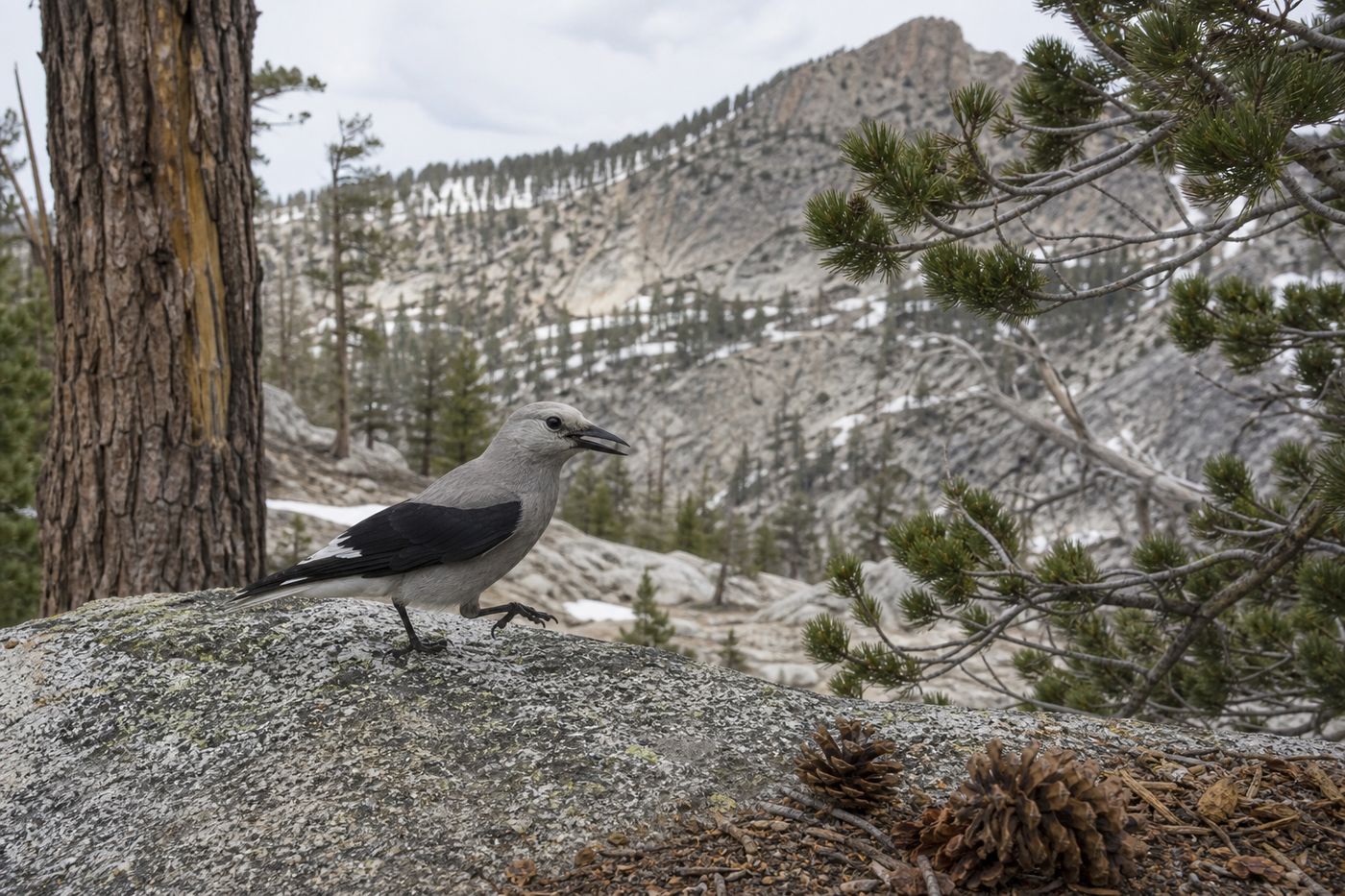
Every autumn, a small woodland bird called the Clark's nutcracker sets out on a task that sounds impossible for a brain the size of a walnut. It buries as many as 30,000 pine seeds across dozens of square miles, hiding each stash in a slightly different spot.
It doesn't do this once. Researchers have tracked nutcrackers making thousands of individual caching trips in a single season, each one a separate memory the bird has to store somewhere in its skull.
Here's the part that stumped scientists for decades: nutcrackers don't rely on smell or random searching to find their buried seeds again. They use visual landmarks, memorizing the exact position of rocks, logs, and shrubs relative to each hiding spot.
Months later, often buried under feet of snow, the bird returns and digs with startling precision, sometimes locating a cache within inches. Studies suggest they recover the majority of their hoards long after the landscape has visibly changed.
This kind of spatial memory outperforms almost anything else tested in the animal kingdom, including primates in comparable lab tasks. Neuroscientists have found that the hippocampus, the brain region tied to memory, actually grows larger in nutcrackers during caching season.
Not every seed gets reclaimed, though, and that's where the story gets bigger than one bird. The seeds nutcrackers forget become the next generation of pine trees, meaning entire forests owe their spread to a bird's imperfect memory.
Whitebark pine, in particular, depends almost entirely on this bird for reproduction. Without the nutcracker's seasonal burying spree, one of the most important trees in western mountain ecosystems would struggle to exist at all.