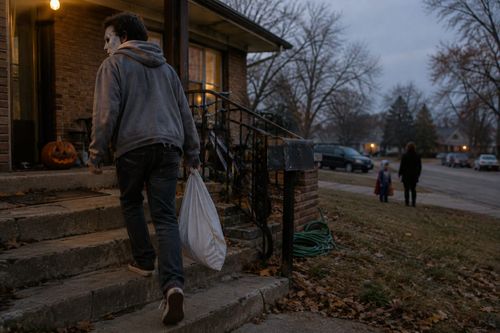
In 1978, the crew of a tiny horror film had almost no money. Director John Carpenter needed a blank, creepy face for his killer, and the budget for it was close to nothing.
Art director Tommy Lee Wallace headed to Bert Wheeler's Magic Shop on Hollywood Boulevard. He came back with a couple of masks, and one of them cost about two dollars, with some sources putting it at $1.98.
Wallace also found a mask of the clown Emmett Kelly, and the team seriously considered using it. Michael Myers could have stalked Haddonfield with a sad hobo face instead.
The mask they chose needed work. The crew removed the eyebrows and sideburns, painted the face white, spray painted the hair black, and reshaped the eye holes to make them wider and emptier.
The mask came from a mold of a famous actor's face, made for the 1975 film The Devil's Rain. Under all that white paint was William Shatner's face, sold in shops as a Captain Kirk mask.
Years later, working on Halloween 2 in 1981, Rick Sternbach spotted a model number and "Don Post Studios" molded into the neck area. A phone call confirmed it was the company's Captain Kirk mask.
Shatner didn't learn about it for years. When he finally heard it in an interview, he reportedly thought it was a joke. Horror's most chilling face started life as a very small bet on Hollywood Boulevard.