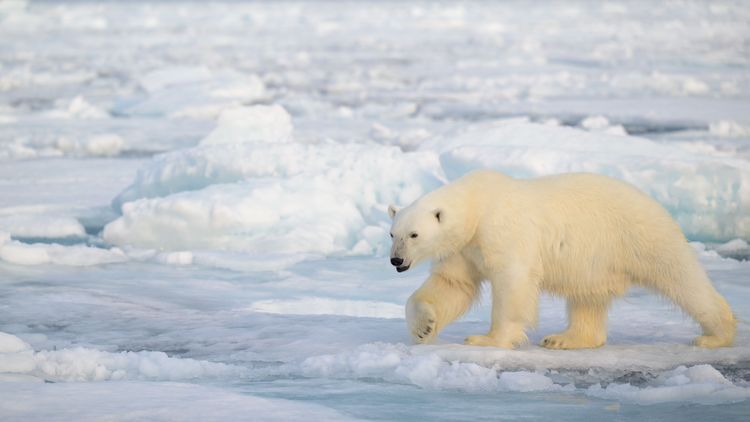
Every polar bear in the wild is left-handed, making them the only animal species with universal handedness across the entire population. While most animals show mixed preferences like humans, polar bears evolved to be exclusively left-paw dominant.
This isn't random - it's a hunting adaptation that developed over thousands of years. When polar bears hunt seals through breathing holes in Arctic ice, they need to use precise, powerful strikes to catch their prey before it escapes underwater.
The left-paw preference gives polar bears a mechanical advantage for this specific hunting technique. They brace themselves with their right paw while delivering devastating downward strikes with their stronger left paw. This coordination between dominant and supporting limbs increases their hunting success rate significantly.
Scientists have observed this behavior across polar bear populations in Canada, Alaska, and the Arctic. Every bear they've studied shows the same left-paw dominance when fishing, hunting, and manipulating objects. It's genetically encoded rather than learned behavior.
What makes this even more remarkable is that polar bear cubs are born with this preference already programmed into their brains. They don't learn to be left-handed from their mothers - the trait is inherited and appears automatically as they develop.
The left-paw dominance extends beyond hunting. Polar bears use their left paw preferentially for digging dens, breaking ice, and investigating new objects. It's their default for any task requiring precision or strength.
This universal handedness makes polar bears unique in the animal kingdom. While some species show slight population preferences for one side or the other, no other animal has 100% consistency like polar bears do.
The evolutionary pressure that created this trait shows how specific environmental challenges can shape entire species in unexpected ways.