Beneath your feet lies one of nature's most sophisticated communication networks—and it's been operating for millions of years without a single Wi-Fi password.
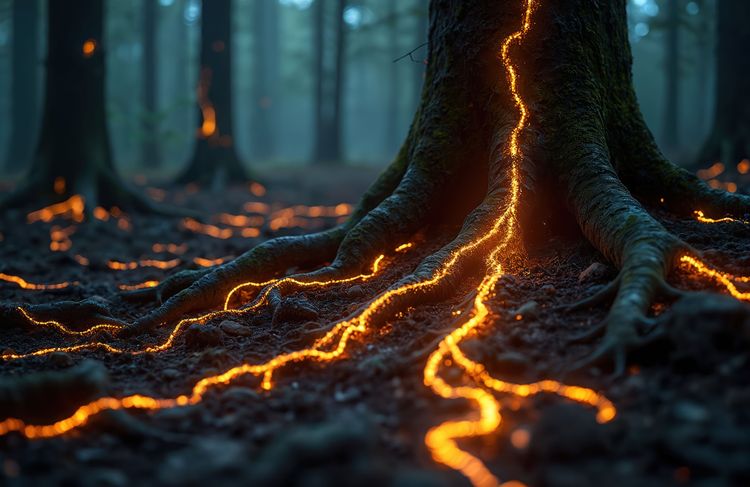
Trees don't just stand silently in forests; they're constantly chatting, sharing resources, and even gossiping through an underground internet made of fungal threads called mycorrhizae.
This "wood wide web" allows trees to warn neighbors about incoming insect attacks by releasing chemical alarm signals, share nutrients with struggling saplings, and coordinate forest-wide responses to droughts, deforestation or diseases.
Mother trees can actually recognize their own offspring and send them more resources than stranger seedlings. When a tree is dying, it downloads its stored nutrients to nearby trees through this network—nature's version of a final backup to the cloud. Scientists have discovered that a single forest can contain networks spanning hundreds of acres, with some fungal connections lasting decadesand facilitating complex social behaviors that rival human communities.
The fungal networks are so efficient that they can transport carbon, nitrogen, and phosphorus between trees faster than the trees' own root systems. Research has shown that when one tree is under attack by bark beetles, it can send chemical distress signals through the network that cause neighboring trees to pre-emptively boost their own defensive compounds.
Even more fascinating, older "hub" trees serve as information centers for entire forest communities, connecting dozens of younger trees and acting like biological internet servers.
These ancient trees can live for centuries while maintaining hundreds of fungal partnerships simultaneously. When scientists artificially sever these connections, the survival rates of younger trees drop dramatically, proving that forests truly function as interconnected superorganisms rather than collections of individual plants.
This makes deforestation and logging far more devastating than most people realize. When we clear-cut forests or remove key hub trees, we're not just taking individual plants—we're destroying communication networks that took decades to establish.
The fungal internet gets severed, leaving surviving trees isolated and vulnerable, unable to share resources or coordinate responses to threats. It's like suddenly cutting all the fiber optic cables in a major city—the entire ecosystem loses its ability to function as a connected community.