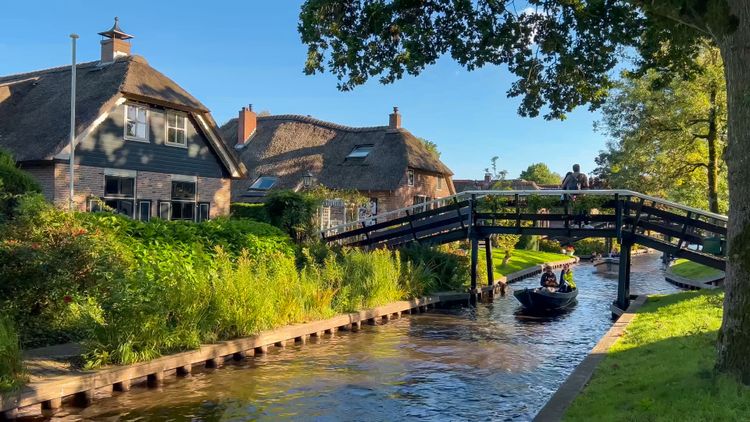
There's a picturesque Dutch village that completely vanishes beneath the waves twice every day, yet residents go about their daily lives as if living underwater is perfectly normal.
Giethoorn, Netherlands, sits below sea level and floods predictably with each high tide. Streets become canals, sidewalks disappear, and entire neighborhoods go completely underwater for hours at a time.
Residents have adapted in ways that seem impossible to outsiders. Homes are built on adjustable stilts that rise and fall with water levels. Cars are replaced with boats that locals keep tied to their front doors like suburban driveways.
The postal service operates on tide schedules rather than regular hours. Mail carriers switch between bicycles and kayaks depending on whether the streets are dry or submerged. Package deliveries happen only during low tide windows.
Local businesses have dual operating systems. Restaurants serve customers at ground level during low tide and move to second-floor locations when water levels rise. Some shops have underwater viewing windows for customers arriving by boat.
Children learn to swim before they learn to walk because getting to school often requires navigating flooded streets. The local school has boat parking alongside traditional bicycle racks.
What's most remarkable is how routine this seems to residents. Flood schedules are posted like bus timetables, and everyone plans their day around when their neighborhood will be accessible by land versus water.
Tourism thrives on this twice-daily transformation. Visitors can experience the same village as both a traditional Dutch town and a floating water community within the span of a few hours.
That charming Dutch village proves that humans can adapt to almost any environmental challenge - even living in a place that disappears and reappears with the rhythm of the tides.