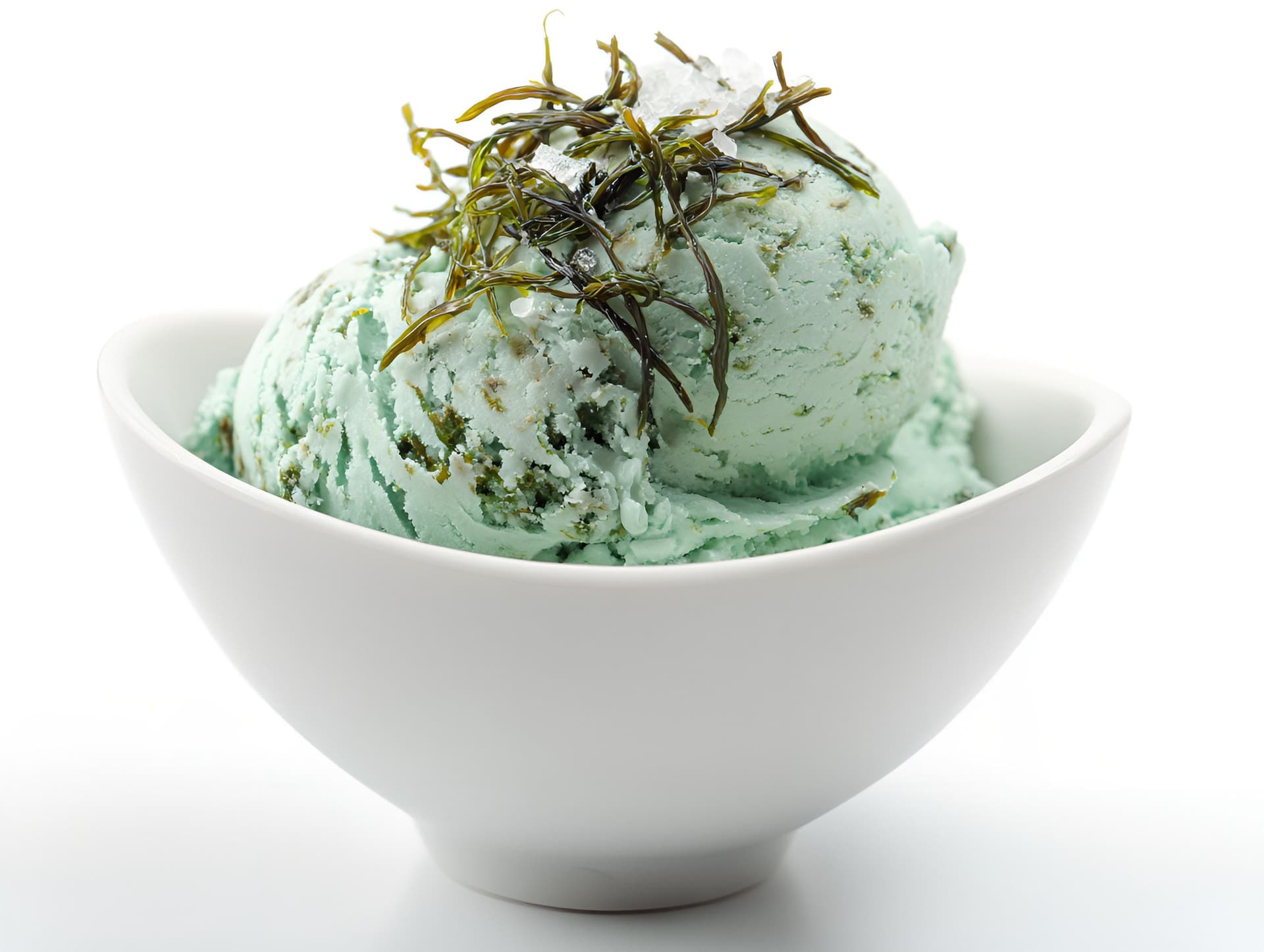
Go look at the ingredient label on your ice cream. If it says "carrageenan," you've been eating seaweed — processed seaweed — without ever really knowing it. Carrageenan is a thickening agent derived from red algae, and it's in an enormous range of everyday foods: ice cream, cottage cheese, chocolate milk, yogurt, coffee creamer, deli meats, almond milk, vegan cheese, and more.
It has no flavor. It has no nutritional value. Its entire purpose is to improve texture — to make your ice cream feel creamier, to stop your almond milk from separating, to give your low-fat deli turkey a satisfying chewiness it wouldn't otherwise have. The food industry loves it because it's cheap, versatile, and derived from something "natural" enough to appear in organic products.
The FDA has classified carrageenan as "Generally Recognized as Safe" — a designation it received back in 1961, long before a large body of research began raising uncomfortable questions. Cell studies and animal experiments have repeatedly linked carrageenan to gut inflammation, intestinal damage, and disruption of beneficial gut bacteria. Researchers sounded the alarm as early as the late 1960s, and the debate has never really stopped.
Here's the detail that tends to get people's attention: there are two forms of carrageenan. The "food-grade" version is processed with alkaline solutions. But when carrageenan is processed with acid instead, it creates a substance called poligeenan — a known inflammatory agent so reliably effective at causing gut damage that scientists use it specifically to induce inflammation in lab animals when testing anti-inflammatory drugs. The food-grade version is not poligeenan. But some researchers have raised concerns that stomach acid could convert trace amounts inside the body.
In 2008, Dr. Joanne Tobacman — a University of Illinois researcher who had spent years studying carrageenan — formally petitioned the FDA to remove it from the food supply entirely. The FDA rejected her petition, citing industry-sponsored research that found no significant human health risk at normal consumption levels. Her publicly funded research said otherwise.
The controversy eventually reached the organic food world. The National Organic Standards Board voted in 2016 to remove carrageenan from the list of substances allowed in USDA organic food. The USDA didn't implement the recommendation — but the vote alone was enough to push many organic brands to quietly reformulate their products anyway, replacing carrageenan with alternatives like gellan gum or locust bean gum.
There's also a labeling problem. If carrageenan is used as a processing aid rather than a direct ingredient — during beer production, for example, or in the cream used to make ice cream — it may not legally be required to appear on the label at all. It can also be listed under names like "sea moss," "Irish moss," or "red algae," labels that sound considerably more wholesome than a 50-year-old scientific controversy.
The honest answer is that the science is genuinely unsettled. Multiple international food safety agencies have reviewed the research and maintained that carrageenan is safe. Other researchers remain unconvinced, particularly for people with inflammatory bowel conditions, who have reported dramatic improvements after removing it from their diet. What's certain is that almost everyone in a developed country is eating it regularly — and almost no one knows it's there.