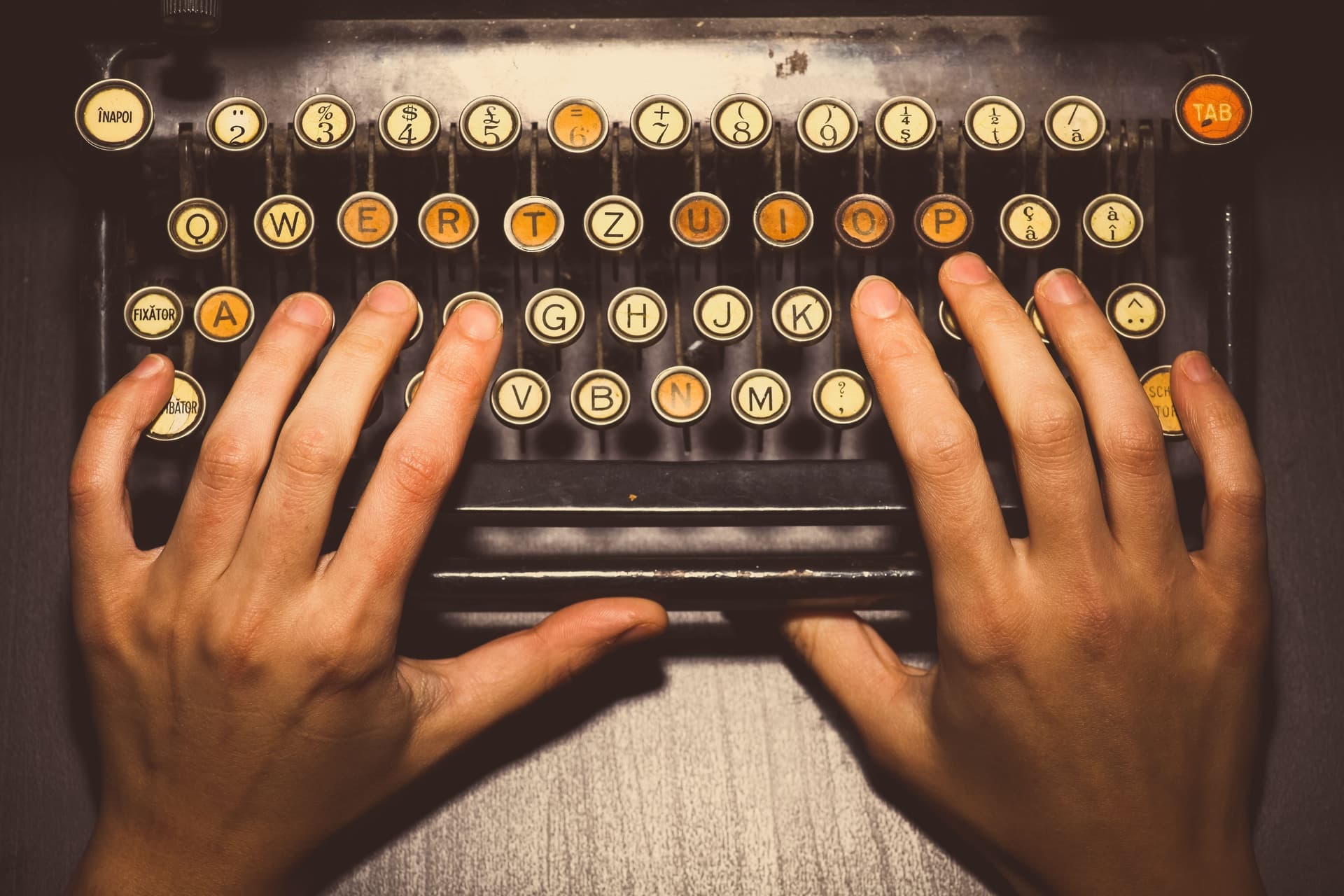
Look down at your keyboard. Those keys aren't arranged randomly—but they're not arranged efficiently either. The QWERTY layout was designed in the 1870s to solve a problem that hasn't existed for over a century. And we're all still stuck with it.
The layout was created by Christopher Latham Sholes for early mechanical typewriters. These machines had a major flaw: if you typed too fast, the metal bars (called typebars) would jam together and get stuck. The mechanism was slow to reset, and rapid typing meant constant mechanical failures.
Sholes' solution was to redesign the keyboard to separate commonly-used letter pairs. By placing frequently-typed letters like "E" and "R" or "T" and "H" far apart, he reduced the chances of adjacent typebars colliding. The QWERTY layout wasn't designed to make typing easier—it was designed to prevent the machine from breaking.
Here's the problem: that mechanical jamming issue disappeared with electric typewriters in the 1960s, and completely vanished with computers. Modern keyboards have no moving parts that can jam. The original reason for QWERTY's existence has been obsolete for over 60 years—but we're still using it.
Better alternatives exist. The Dvorak Simplified Keyboard, patented in 1936, puts all vowels in the home row and optimizes for efficiency. Studies show it's faster, less fatiguing, and more ergonomically sound than QWERTY. Some estimates suggest Dvorak users can type 10-15% faster with significantly less finger movement.
There's also Colemak, released in 2006, which changes only 17 keys from QWERTY but dramatically improves efficiency. Both layouts are scientifically superior to QWERTY in every measurable way. So why doesn't anyone use them?
Because we're locked in. Remington, the company that manufactured Sholes' typewriter, trained millions of typists on QWERTY starting in the 1870s. By 1893, when major typewriter manufacturers merged to form the Union Typewriter Company, QWERTY had become the industry standard. Everyone had already learned it.
This created what economists call "path dependence"—we're stuck with an inferior system because the cost of switching is too high. Retraining every typist, replacing every keyboard, updating every device would cost billions. Even though better options exist, we're trapped by a decision made 150 years ago to accommodate mechanical limitations that no longer exist.
So every time you reach across your keyboard to hit a common letter, remember: you're using a layout specifically designed to slow down 19th-century typewriters. The inefficiency you're experiencing isn't a bug—it was the original feature. We just never bothered to upgrade.