Animal Facts

Recent Content

The History of the New Year's Baby vs Old Man Time

The History of the New Year's Baby vs Old Man Time

The New Year's Baby and Old Man Time mascots symbolize the year changing. Both were invented by political cartoonists in the 1800s to sell newspapers.

Read more
Why 80% of New Year's Resolutions Fail by February

Why 80% of New Year's Resolutions Fail by February

80% of New Year's resolutions fail by February. Brain science explains why we're biologically terrible at keeping them—and why January 1st makes it worse.

Read more
The First Ball Drop Almost Killed People

The First Ball Drop Almost Killed People

The 1907 Times Square ball was 700 pounds of iron and wood. It nearly fell during the first drop, almost killing the crowd below.

Read more
How January 1st Became New Year's Day

How January 1st Became New Year's Day

Julius Caesar picked January 1st as New Year's Day in 46 BC. Before that, the new year was March 1st—which is why our month names don't make sense.

Read more
Why Boxing Day Is Called Boxing Day

Why Boxing Day Is Called Boxing Day

Boxing Day started as the one day British servants got off after working Christmas. They received boxes of leftovers and tips from their employers.

Read more
See All Content
logo
  • Sports

  • History

  • Language

  • Food

  • Tech

  • Animals

  • Sports

  • History

  • Language

  • Food

  • Tech

  • Animals

  • ​
    ​

Why Cats Always Land on Their Feet

Why Cats Always Land on Their Feet

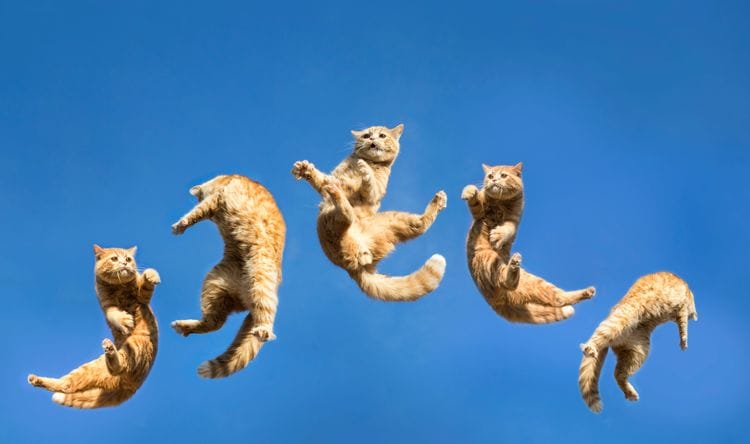
Cats can rotate their bodies 180 degrees while falling without violating the laws of physics —a feat that seems impossible but happens automatically every time a cat falls. This "righting reflex" kicks in when cats are just 3 weeks old and works even when they're blindfolded.

The secret is that cats don't rotate their whole body at once.They rotate their front half and back half in opposite directions, which cancels out the angular momentum and allows them to flip without pushing against anything. It's like a biological gyroscope that defies Newton's laws.

Cats start the flip by tucking their front legs close to their body while extending their back legs, making their front half spin faster than their back half. Then they reverse the process, extending their front legs and tucking their back legs to complete the rotation. The two halves spinning in opposite directions allow the cat to flip without external force.

NASA studied cat falling mechanics to help astronauts orient themselves in zero gravity.The same principles cats use to land on their feet work in space where there's no gravity or air resistance to push against.

Cats also have incredibly flexible spines with 30 vertebrae (humans have 24), allowing them to rotate their bodies in ways that would injure other animals. Their inner ear contains a super-sensitive balance system that instantly detects falling and triggers the automatic flip response.

Every time your cat jumps off something, they're performing a physics miracle that NASA engineers are still trying to fully understand.
Related Content

Terms and ConditionsDo Not Sell or Share My Personal InformationPrivacy PolicyPrivacy NoticeAccessibility NoticeUnsubscribe
Copyright © 2026 Fun Fact Feed