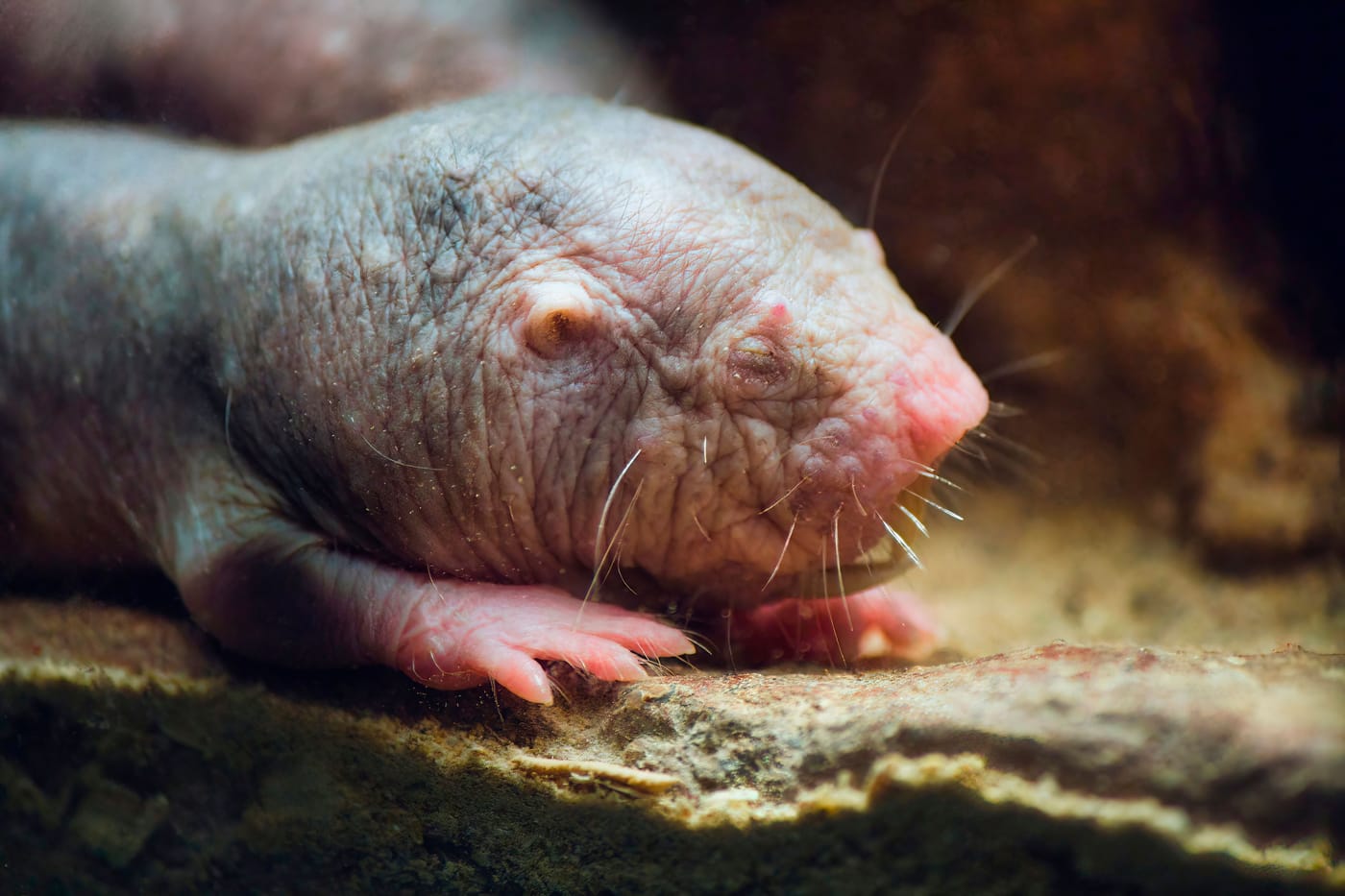
The naked mole rat is not a conventionally appealing animal. It's nearly hairless, nearly blind, wrinkled like a thumb left too long in water, and lives its entire life underground in dark, oxygen-depleted tunnels beneath the arid plains of eastern Africa. It also happens to be one of the most scientifically significant animals on the planet — and researchers have spent decades trying to understand why it refuses to follow the rules.
Start with lifespan. A mouse lives two to three years. The naked mole rat, roughly the same size, lives up to 37 years — nearly ten times longer than its closest relatives. More unusually, it doesn't appear to age in the way every other known mammal does. In most species, the risk of dying increases with age. In naked mole rats, that risk stays essentially flat across their entire lives. A 30-year-old naked mole rat has roughly the same probability of dying on any given day as a one-year-old. Scientists call this "negligible senescence," and it violates a biological law that was thought to apply to every mammal on earth.
Then there's cancer. In decades of observing large naked mole rat colonies, researchers have not recorded a single spontaneous case of cancer. To test whether this resistance held up under pressure, scientists exposed the animals to a chemical carcinogen at 1,000 times the dose that reliably causes cancer in mice. No tumors developed. The mechanism behind this appears to involve a substance the animals secrete in unusually high concentrations — a form of hyaluronan, a natural lubricant found in many mammals, but in naked mole rats produced at molecular weights five times larger than in humans or mice. When cells begin to crowd together in the way that precedes tumor formation, this substance appears to halt the process before it starts.
Pain works differently for them too. Naked mole rats lack the neurotransmitter substance P, which plays a central role in how mammals process certain types of pain. They feel mechanical pain normally — they respond to pressure and heat — but they are essentially immune to the burning pain caused by acid and capsaicin. They can sit in an acidic environment that would be agonizing to any other mammal and show no distress response whatsoever. Researchers studying chronic pain conditions have been examining this trait closely, looking for ways to replicate the effect in human pain treatment.
Their relationship with oxygen is equally strange. Naked mole rats live in tunnels where oxygen levels can drop low enough to be fatal to most mammals. They have evolved to survive up to 18 minutes of complete oxygen deprivation — a feat no other known mammal can match. When oxygen runs out, their metabolism switches to a fructose-based energy system, essentially running their cells on a backup fuel source that bypasses the need for oxygen entirely. The implications for understanding stroke and heart attack damage — both of which kill cells through oxygen deprivation — have not been lost on researchers.
Part of the longevity secret appears to involve DNA repair. A recent study published in the journal Science identified a modified version of a common protein — cGAS — that functions differently in naked mole rats than in other mammals, allowing their cells to repair DNA damage far more efficiently. When this gene was introduced into mice, the mice lived longer and showed greater resistance to tumors. It wasn't a complete transfer of the naked mole rat's abilities, but it was enough to confirm that the mechanism was real and potentially transferable.
What makes the naked mole rat so valuable to researchers isn't just what it can do — it's that it does it naturally, as a product of evolution rather than genetic engineering. Every ability the animal has developed is a proof of concept: pain resistance, cancer immunity, negligible aging, oxygen deprivation survival. Nature already solved these problems. The scientific challenge now is figuring out exactly how, and whether any of it can be translated into medicine for a species that is, in almost every relevant biological way, far less impressive than a small, blind, wrinkled rodent living underground.