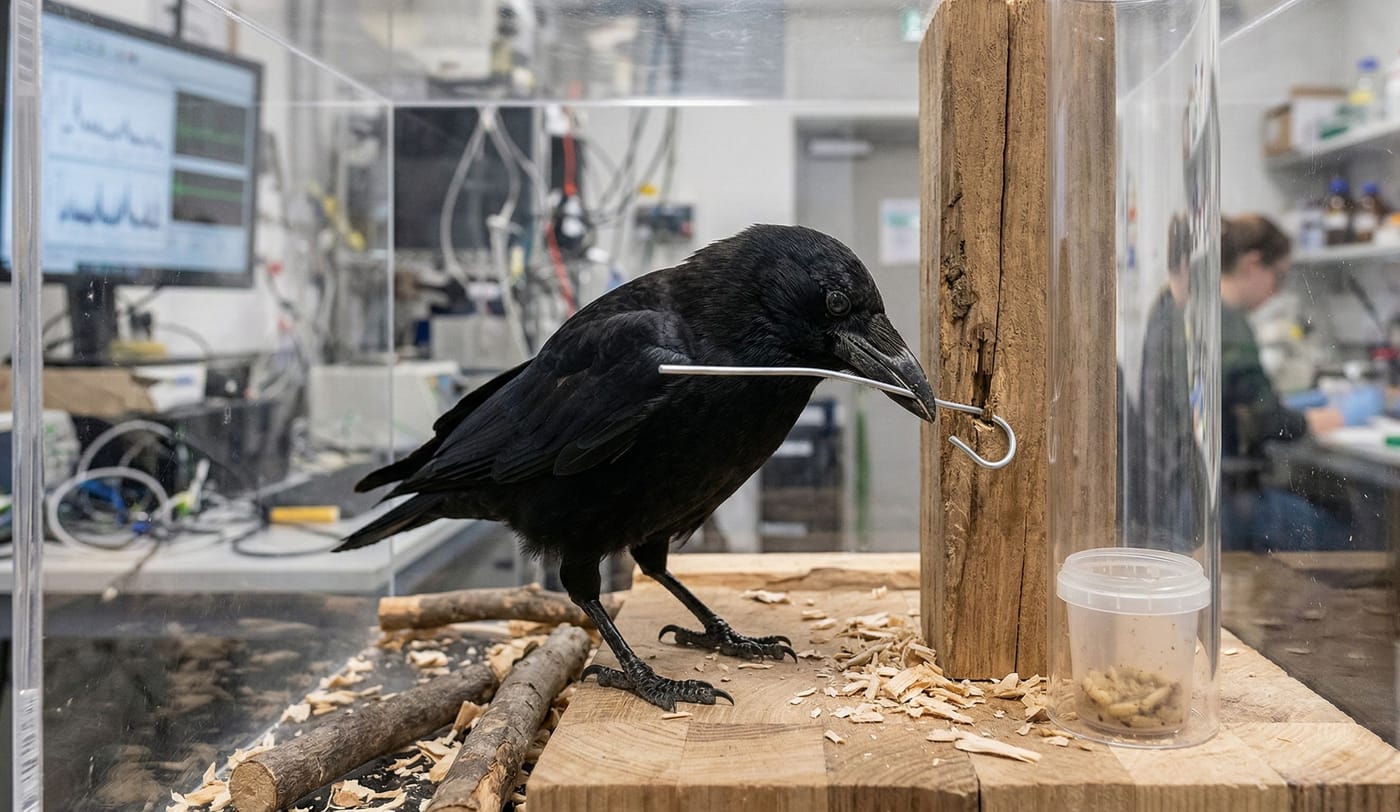
In 2002, a New Caledonian crow named Betty was presented with a task: retrieve a small basket of food from inside a vertical tube using a straight piece of wire. Her hooked stick — the tool she'd intended to use — had been taken away by another crow. Betty examined the straight wire, bent it into a hook using her beak and a crack in the floor of the enclosure, and retrieved the food. She had never seen a hook before. She had never been taught to bend wire. She did it on her first attempt. The researchers running the experiment had not designed it to test hook-making. They had no idea she was going to do it.
New Caledonian crows live on a remote tropical island in the South Pacific and are, by most measures, the most sophisticated tool users in the animal kingdom outside of humans and great apes. They don't just use tools — they manufacture them. In the wild, they select specific plants, tear leaves into precise shapes, and trim twigs to exact specifications to create hooks and probes for extracting grubs from inside trees. The tools vary in design depending on the specific task — a hook for one type of cavity, a straight probe for another — which means the birds are selecting and modifying materials based on an assessment of what a particular job requires.
What separates New Caledonian crows from most other tool-using animals is that their tools show signs of cumulative improvement across generations — a hallmark of culture that, until recently, scientists believed was unique to humans. The tool designs used by crow populations have grown more sophisticated over time, with features that a single bird couldn't have invented alone — improvements that appear to have been passed down through social learning, each generation building on what the previous one developed. Researchers call this cumulative technological culture, and the crow may be the only non-primate species that demonstrably has it.
The mechanism behind this cultural transmission is itself remarkable. New Caledonian crows don't appear to imitate each other directly — they don't watch another crow make a tool and copy the movements. Instead, they seem to form what researchers call a "mental template" — a stored internal model of what a successful tool looks like — and then manufacture their own version from memory. An improvement made by one crow can become part of the template learned by the next generation, leading to tools that grow more complex over time without any single bird having designed the whole thing.
In captivity, the experiments designed to test their limits keep producing unexpected results. New Caledonian crows have been observed using one tool to access a second tool needed to access food — a level of sequential planning that requires holding a future goal in mind across multiple steps. They have solved eight-step puzzles involving combinations of levers, weights, and containers. They have inserted sticks into objects specifically to carry two things at once. They have been observed placing food on heat lamps — a behavior that researchers describe as possible proto-pyrocognition, the very early cognitive precursor to understanding fire.
The question researchers keep returning to is why. New Caledonian crows don't have an unusually large brain relative to their body size — not compared to primates, and not even compared to some other corvids. What they appear to have is a specific neural architecture that supports causal reasoning — the ability to understand not just that one thing follows another, but why. This is the cognitive foundation of tool design: you can't engineer a hook if you don't understand the mechanical relationship between the hook and the thing you're trying to retrieve.
Betty, the wire-bending crow, died in 2005. She had passed every test her researchers designed for her and invented solutions to several they hadn't anticipated. The study she accidentally inspired — on spontaneous hook manufacture in a non-human animal — became one of the most cited papers in animal cognition research. The researchers had set out to study something else entirely. She had different plans.
Scientists keep building harder puzzles. The crow keeps solving them.